
ASIAN CIVILISATIONS MUSEUM · FIELD TRIP GUIDE
Into the Dunhuang Caves
敦煌:佛教艺术与丝绸之路
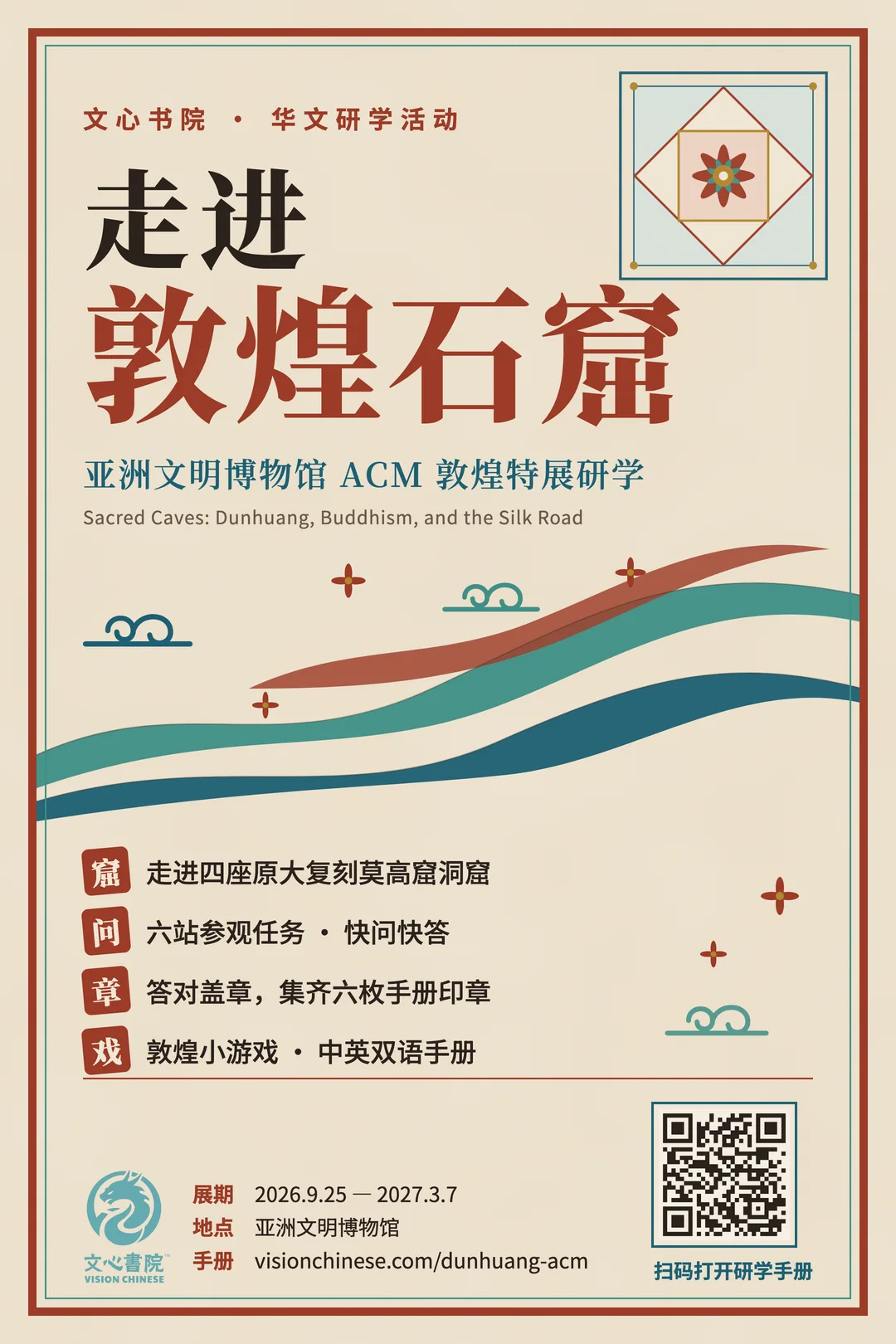
You don't need to cross the Gobi Desert to step inside the Mogao Caves. Four full-size cave reproductions are here in Singapore. Follow this guide stop by stop, answer the quick quiz at each one, and collect a guide seal.
Plan your visit
Read this before you go
- DATES
- 25 Sep 2026 – 7 Mar 2027
- HOURS
- Daily 10am – 7pmFridays until 9pm
- VENUE
- Asian Civilisations Museum1 Empress Place, Singapore 179555
- GALLERIES
- Level 2 Shaw Foyer + Special Exhibitions GalleryCave 158 is in the Foyer; the other three are in the gallery
- TICKETS
- Singaporeans / PRs S$10 (adult)Other visitors from S$15; concessions for students and seniors
- GETTING THERE
- Raffles Place MRT5–8 minutes on foot, next to Merlion Park
Prices and programmes may change. Check the ACM website before you go. Allow 2–3 hours.
- 1Prologue: the Silk RoadGallery entrance · maps, textiles and manuscripts
- 2Cave 249 · Western WeiSpecial Exhibitions Gallery · myth and the cosmos
- 3Cave 45 · High TangSpecial Exhibitions Gallery · seven painted sculptures
- 4Cave 3 · YuanSpecial Exhibitions Gallery · Thousand-armed Guanyin and line drawing
- 5Treasures and conservationSpecial Exhibitions Gallery · paintings, sutras, donors
- 6Cave 158 · Mid TangLevel 2 Shaw Foyer · the reclining Buddha
Follow the signs in the gallery for the actual route. Cave 158 sits outside the gallery in the Foyer, so you can see it first or last.
Gallery rules
- No flash photography inside the caves. Don't touch the cave walls or display cases.
- The caves are small. Go in by groups and keep your voice down.
- ACM stamp trail: find all 6 stamps in the exhibition to reveal a Nine-Coloured Deer illustration to take home. Bank of China and The Fullerton Hotel have bonus stamps.
- From 2 October, collect 6 stamps across the exhibition and ACM's permanent galleries to redeem an apsara blind-box figurine, while supplies last.
- Cave of Colours in the Level 1 lobby: collect a Magic Brush to hunt for Dunhuang colours, and dress up in cave-inspired costumes.
- ACM also offers official activity booklets in English and Mandarin (ages 7–12 and 13+). Download them from the exhibition page.
Six-stop missions
Four cave reproductions plus two gallery stops. Look closely, write down your ideas, then take the quiz to earn a seal
Dunhuang games
Play on the bus or back in class
Cave time machine
The four caves come from different dynasties. Tap them in order, from oldest to newest.
The Nine-coloured Deer
This is one of Dunhuang's best-known mural stories (the original is in Mogao Cave 257). Tap the sentences in story order.
Cave guardian
Does this protect the murals or harm them? Answer 8 in a row.
Field trip worksheet
Saved automatically on this device
For teachers
Trip notes, answer keys and follow-up work
Notes for group leaders
- Allow 2–3 hours. Cave 158 in the Level 2 Foyer works well as a meeting point.
- The cave reproductions are small. Send groups of 6–8 at a time, about 8–10 minutes per cave.
- Remind students: no flash, no touching the walls or cases, quiet voices inside the caves.
- Students can fill in the worksheet on their phones, then tap "Copy my worksheet" and send it to you.
- ACM's stamp trail and the Cave of Colours Magic Brush make good group rewards. The official ACM activity booklets work well alongside this guide.
Pre-visit questions
Where is Dunhuang, and why did merchants and monks go there?
Dunhuang is at the western end of the Hexi Corridor in Gansu Province, China. It was the gateway between central China and the lands to the west on the Silk Road. Caravans rested and restocked there, and monks travelling in both directions stopped there, so it grew into a major cultural centre.
What are the Mogao Caves, and who dug the first one?
The Mogao Caves, also called the Caves of the Thousand Buddhas, are cut into the cliff at the foot of Mingsha Mountain. According to records, a monk named Le Zun dug the first cave in 366 CE. Over the next thousand years people kept adding more; 735 caves survive today.
Follow-up activities
- Draw an apsara (flying celestial) or one of the mythical beasts from Cave 249, with a one-line caption.
- Write a 300–500 word essay: "I Walked into the Dunhuang Caves".
- Group discussion: we saw a Dunhuang exhibition in Singapore. How can Chinese culture reach people around the world?
Model essay: "I Walked into the Dunhuang Caves"
Today our class visited the Dunhuang exhibition at the Asian Civilisations Museum. The cave reproductions had travelled all the way from China, so I could walk into thousand-year-old caves without leaving Singapore.
The four caves come from different dynasties, and each has its own style. The ceiling of Cave 249, from the Western Wei, is covered with mythical beasts and flying celestials, like a map of the universe. In Cave 45, from the High Tang, seven painted sculptures each have a different expression: the bodhisattvas look gentle and graceful, while the heavenly kings look fierce. The whole group shows the confidence of a golden age. Cave 3, from the Yuan dynasty, is painted almost entirely in line, yet the scarves of the Thousand-armed Guanyin seem to float in the wind. The most striking was the huge reclining Buddha in Cave 158. He lies calmly on his side while the disciples around him weep or think quietly, and the whole cave felt still.
I remember the story of the Nine-coloured Deer best. It teaches us to keep our promises and repay kindness. The murals also show clothes, musical instruments and carriages from long ago, like a history book told in pictures.
For centuries, sand and moisture have worn away the murals at Mogao, and protecting them is hard work. Bringing reproductions to Singapore lets people like us see the beauty of Dunhuang up close. Chinese culture has crossed mountains and seas to meet us here.
Discussion guide: sharing Chinese culture overseas
- Touring exhibitions with cave reproductions give visitors an immersive experience.
- Chinese language classes can run Dunhuang and Silk Road field-trip units.
- Picture books, animation and children's art workshops make the stories easy to enter.
- Guided tours and talks can reach visitors of every age.
ABOUT US
This guide is made by Vision Chinese Academy
Vision Chinese Academy (文心书院) is a Chinese language school in Singapore, with centres at Orchard, Telok Ayer and Kuala Lumpur. We teach Chinese from kindergarten to high school, covering PSLE, O-Level, IGCSE, IBDP and AP Chinese, with online classes for overseas families.
Planning a school trip to the Dunhuang exhibition, or looking for Chinese classes? Get in touch. Feel free to save the poster and share it with parents and colleagues.